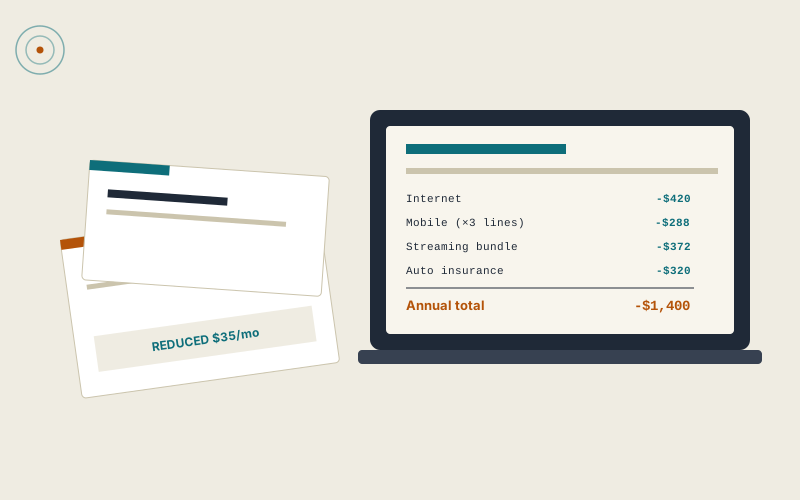
The most useful weekend we've spent in the last twelve months wasn't outside. It was at the kitchen table, with a laptop, a pile of opened envelopes, and a printed list of every recurring charge on our checking and credit-card statements. Two days later, we'd lowered our annual outflow by $1,400 — and we'd done it without canceling anything we actually use.
This article is the entire playbook, in the order we ran it, with the dollar amounts that moved. No "weird tricks," no apps. Just a few phone calls and a willingness to spend an afternoon doing something most people would rather not.
Step 1 — Inventory, sorted by dollar size
We started by exporting the last 12 months of statements and pulling every recurring charge into a spreadsheet. One row per charge, one column for monthly cost. Then we sorted descending. The list looked roughly like this:
- Auto insurance (full coverage, two cars) — $153/mo
- Internet + landline bundle — $112/mo
- Mobile (3 lines, postpaid) — $148/mo
- Streaming services (eight of them) — $97/mo
- Home security monitoring — $44/mo
- Gym + a small clutch of misc. subscriptions — $63/mo
Sorting by dollar size matters. It's the single most boring step and also the only one that's not negotiable. If you skip it, you'll spend an hour canceling a $4/month thing while ignoring the $150/month thing right next to it. We've done that, and we don't recommend it.
Step 2 — Pick the order by switch-friction, not by size
The biggest line items aren't always the easiest ones to attack. Auto insurance is high-dollar but it's also a two-hour-of-quotes job. Streaming is low-dollar but you can cancel five things in twenty minutes. We put together a rough "switch-friction" rank and worked easy-first to build momentum:
- Streaming & subscriptions — friction: very low.
- Internet bundle — friction: medium (one phone call, retention department).
- Mobile plan — friction: medium-high (porting numbers, BYOD check).
- Auto insurance — friction: high (multiple quotes).
- Home security — friction: contract-dependent.
Step 3 — The Saturday morning work (low-friction wins)
We started with streaming because it warms you up. We made two lists: services someone in the household had used in the last 30 days, and services no one had touched in 90+. The 90-day group went immediately. That alone: $31/mo, $372/yr.
For the survivors, we picked the two we used most and committed to a rolling rotation rather than holding all of them year-round. We've written about that in detail in our streaming-rotation calendar. The annualized win for us, accounting for what we actually re-subscribe to, was an additional $320/yr.
Other low-friction wins in the same hour:
- Gym membership — kept (we use it). Asked for and got a "loyalty rate" by mentioning a competitor's promo: $8/mo, $96/yr.
- Three forgotten app subscriptions — canceled outright: $11/mo, $132/yr.
By lunchtime we'd already crossed $900/yr without picking up the phone. We took a break.
Step 4 — Saturday afternoon: the internet bundle
This is where the phone calls start. We use the same negotiation script for every "monopoly-ish" provider — internet, mobile, home alarm. The full script is in our bill-negotiation script article. The short version:
- Pull a competing offer in writing first (screenshot is fine).
- Call. Ask politely about the rate (not "my bill").
- Anchor: "I have a written offer for $X from [competitor]."
- Ask the magic question — "What's the best you can do today?"
- Pause. Don't fill the silence.
- If the front-line rep can't help, ask to be transferred to retention.
Our internet provider's first offer was a $15/mo discount for 12 months. We held the line. We mentioned that we'd received a quote at $59/mo for similar speeds. Their second offer was $20/mo off plus removal of the landline charge we didn't use. Net: $35/mo, $420/yr.
Step 5 — Saturday night: mobile
Mobile is its own playbook. Postpaid carriers charge a meaningful "loyalty tax" — the longer you've been with them, the more your plan typically costs relative to what they offer new customers. For three lines we were paying $148/mo. After about 40 minutes on chat, then escalation to a retention agent, we landed on a comparable plan at $124/mo. $24/mo, $288/yr.
If your monthly is meaningfully higher than that, two specific moves usually outperform negotiation:
- Switch to a prepaid brand owned by the same parent. Same network, often half the price. The trade-off is fewer perks (no streaming-bundle freebies) and slightly slower priority during congestion.
- BYOD onto a discount MVNO. If your phones are paid off, this almost always wins on dollars; ask whether your household actually values the postpaid features before switching.
Step 6 — Sunday morning: auto insurance
This is the highest-dollar lever in most households, and it's where we spent the most time. We've written the long version in "We shopped six car insurance carriers in two hours." The relevant inputs you need before you start clicking:
- Coverage limits (bodily injury, property damage, UM/UIM).
- Comprehensive and collision deductibles.
- Current 6-month premium and renewal date.
- Driving record details (any incidents in the last 3–5 years).
We pulled six quotes on the same coverage profile and got a $612-annual gap between the cheapest and most expensive. We switched: $612/yr, less a $40 one-time policy fee.
Step 7 — Sunday afternoon: home security
This one was almost zero work. Our monitoring contract had expired the previous month. A 15-minute call confirmed we were on month-to-month at the old rate. We asked for the current-customer retention rate. $12/mo, $144/yr off, no equipment changes.
The weekend total
Reconciling against our actual statements three months later:
- Streaming + subscriptions: $452/yr
- Gym loyalty rate: $96/yr
- Internet bundle: $420/yr
- Mobile: $288/yr
- Auto insurance: $612/yr (less $40 fee = $572/yr net)
- Home security: $144/yr
Headline total: $1,972/yr in negotiated and canceled spend. After netting out the $40 policy fee and a $32/year price-creep we picked up later in the year on a streaming reactivation, the durable savings settled at around $1,400.
What this kind of weekend is worth
About 10 hours of work for $1,400/year — roughly $140/hour, tax-free. We're not telling you this to be smug. We're telling you because we spent years assuming bills were just bills. They're not. Most of them are negotiable, and the act of doing it once builds a muscle that pays out every renewal cycle.
If you only have an hour and want the highest-leverage move, do the auto-insurance quote-shop. That single category beat every other move we made.