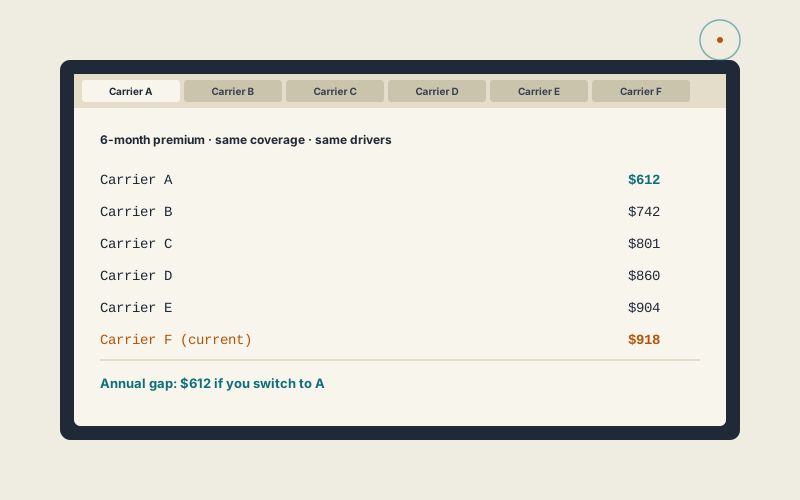
Auto insurance is the single biggest, easiest-to-move line item in most households, and most people never touch it. We spent two hours one Sunday running six quotes against identical coverage limits — same drivers, same cars, same deductibles, same dates — and the gap between the cheapest and most expensive carrier was $612 a year. That's not a rounding error. That's a flight to somewhere with a beach.
Here's exactly how we did it, including the four numbers you should write down before you open a single quote engine.
The four numbers you need before you start
If you skip this step, you'll spend the next two hours getting quotes that are technically incomparable. Don't.
- Your bodily injury and property damage liability limits. Look for something like 100/300/100 on your declarations page. These are the per-person, per-accident, and property-damage caps.
- Your uninsured / underinsured motorist limits. Usually mirror the BI limits.
- Your comprehensive and collision deductibles. Typically $500 or $1,000.
- Your current 6-month premium and renewal date. Both are on the declarations page. The renewal date matters because some carriers charge a cancellation fee mid-term; others don't.
That declarations page is the single most useful document you can have open. We printed ours and put it next to the laptop.
Who we quoted, and why
We pulled six carriers, deliberately mixing:
- Two big national brands (the kind with national TV spots)
- One direct-to-consumer carrier known for low rates and a minimalist agent model
- One large mutual carrier that does well in our state
- One newer "telematics-first" carrier that prices off driving behavior
- Our incumbent carrier (a baseline, not a quote — we just used renewal)
Why a mix? Because every carrier has a different "shape" of customer they want. One carrier rewards homeownership; another rewards a clean MVR record; another rewards low annual mileage. Pulling a single big-brand quote and concluding "I'm getting a fair rate" is, statistically, a bad bet.
The two-hour timeline
We blocked Sunday morning, made coffee, and pulled six tabs.
0:00 – 0:15 · Prep
Declarations page out. VINs typed once into a notes file. Driver info (DOB, license number, license issue date) written down so we'd stop hunting for it. Mileage on each car.
0:15 – 1:30 · Six quotes, identical inputs
Each quote took 12–18 minutes if we already had the inputs ready. Two carriers required a phone call (one wouldn't let us bind online for our state); the other four ran fully self-serve.
For each quote we matched our existing limits exactly. If a carrier's default form auto-bumped our deductibles or added a "rideshare endorsement," we manually fixed it back. The whole point is apples-to-apples.
1:30 – 1:50 · Spreadsheet
One row per carrier. Columns for 6-month premium, billing fees, payment plan options, and the underwriter's name. We screenshotted every quote.
This step is where the gap becomes visible:
- Cheapest: $612 / 6 months
- Carrier B: $742
- Carrier C: $801
- Carrier D: $860
- Carrier E: $904
- Our incumbent (renewal): $918
Cheapest to most expensive: $306 per 6 months. $612 a year.
1:50 – 2:00 · Sanity check
Before we bound the cheap one, we checked three things:
- Financial strength. A.M. Best rating "A" or better is the minimum we'll consider for a primary household policy. Anything lower we left on the table.
- State complaint index. Your state department of insurance publishes a complaint index. Above 1.0 means more complaints than average for the company's size. The cheapest carrier was at 0.7. Fine.
- Bundling break-even. We rent, so home/auto bundles weren't a meaningful lever for us. Homeowners: check the bundle separately. A cheaper standalone auto policy can lose out if it kills a homeowners discount on the other side.
What we actually switched to — and what changed
We switched to the cheapest of the six. Net effect over 12 months: $612 in savings against identical coverage, less a $40 one-time policy fee. The biggest practical change was no longer having a local agent — claims and changes route through the carrier's app and call center. We've had one minor windshield claim under the new carrier; it processed without drama in 11 days.
Common reasons people don't shop, and what we'd say to each
"My carrier already gives me loyalty discounts."
Loyalty discounts are real and usually small. Loyalty-based rate creep over a multi-year customer relationship is also real and usually larger. Net effect varies by state, but at the multi-year mark, most carriers have priced in some assumption that you won't shop. Test it.
"My driving record means I'll get rejected."
Some carriers really won't write you. Plenty will. The point of running multiple quotes is to find out which ones price your specific record competitively rather than guessing.
"I don't have two hours."
Pull two quotes instead of six. It's still better than the zero you're doing now. The marginal value of carrier #3 onward is real but diminishing; the jump from zero quotes to one quote is enormous.
What we'd do differently next time
- Quote bundles for renters and homeowners on the same shopping pass. We did renters separately and probably left a small bundle discount on the table.
- Take the telematics carrier's free trial. Some carriers will run a 30-day driving-behavior trial that determines your final rate, which can drop the headline number. We were too impatient.
- Recheck every renewal cycle. The cheapest carrier today is not the cheapest carrier two years from now. We've calendared a re-quote sprint for next April.
Bottom line
Two hours, six quotes, $612 in annual savings. The "weird trick" is that there is no weird trick. The carriers price on different math, and the only way to find which math is friendly to your specific household is to run the numbers. Most people never do, and the carriers — to their financial benefit — are aware of that.