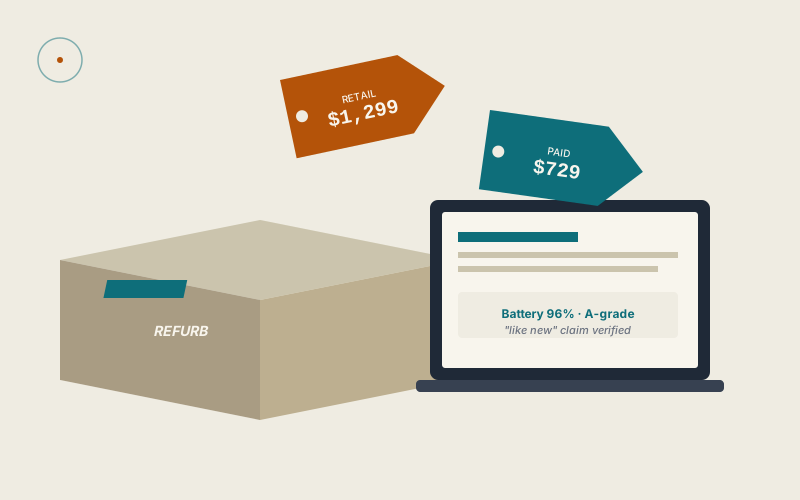
"Refurbished" is one of those words that has done a lot of marketing work in the last decade. Sometimes it means "this device was opened, never registered, and is functionally new." Sometimes it means "this device has had a hard year and someone screwed the case back together." Over twelve months we bought eight refurbished electronics across three categories — laptops, smartphones, and small appliances — to see whether the pattern of which categories are actually a good deal holds up.
It does, and it's predictable. Here's the pattern, with the specific reasons.
The grading system you need to understand
Almost every "refurbished" listing falls into one of these buckets, regardless of what the seller calls it:
- Open-box / returns. Unit was opened, possibly inspected, possibly never used, repackaged. The lowest-touch refurb. Best risk-reward in most cases.
- Manufacturer refurbished. The original maker certified, cleaned, replaced what was broken, and re-tested. Usually comes with a full warranty. The safest refurb.
- Third-party refurbished. Someone other than the maker — a specialty seller, an outlet — did the work. Variable quality. Read the listing language carefully.
- "Used — like new." Almost always not a refurb at all. Treat as a used unit with whatever the seller's return policy is.
If the listing doesn't tell you which of these you're buying, that itself is the answer. Move on.
What we bought, what happened
Category 1 — Laptops (2 purchased)
Unit 1: Manufacturer-refurbished business laptop, A-grade. Retail equivalent: $1,299. Paid: $729. Battery health on receipt: 96%. One small scuff on the lid we genuinely had to look for. Full 12-month manufacturer warranty. After 9 months: working flawlessly, battery still in the mid-90s, no complaints. Verdict: great deal.
Unit 2: Third-party refurbished consumer laptop, "B-grade." Retail equivalent: $899. Paid: $429. The price gap was bigger and that should have been the warning. Visible wear on the wrist rest, hinge slightly loose, battery at 82% on arrival. Worked fine for two months, then the battery degraded fast to 64%. Replaced it under the seller's 90-day "limited warranty," which was a process. Verdict: would not repeat. Manufacturer refurb is worth the extra $150–$200.
Category 2 — Smartphones (3 purchased)
Smartphones are the category where refurbished is consistently the best deal in tech. The unit economics are simple: phones flow back through carrier returns and trade-ins at high volume, and the cosmetic threshold for "like new" is high.
Unit 3: Carrier-certified manufacturer refurb, flagship model, two generations old. $329 versus $799 new for the latest generation. The two-generation gap is the win here — the difference between the latest flagship and a flagship from 24 months ago is minor for almost everyone. Verdict: excellent deal.
Unit 4: Marketplace refurb from a high-rated third-party seller, mid-tier model. $189 versus $399 new. Cosmetically fine, battery health 89%, fully unlocked. Six months in, no issues. Verdict: good deal, but requires diligence checking the seller's return policy and the unit's reported IMEI history.
Unit 5: Open-box from a major retailer, current-model budget phone. $179 versus $229 new. The savings ratio (22%) isn't compelling on a phone this cheap. Verdict: fine, but we'd rather pay an extra $50 for new at this price tier.
Category 3 — Small appliances (3 purchased)
This is the category that surprised us, and not in a good way.
Unit 6: Refurbished stand mixer, manufacturer's outlet. $189 versus $349 new. Arrived as a returned unit, lightly cleaned, missing the dough hook. Customer service replaced the hook within a week. After 12 months: solid. Verdict: good deal — but only because the manufacturer's outlet sells these with a real warranty.
Unit 7: Third-party "renewed" robot vacuum. $159 versus $349 new. Worked for six weeks, then the side brush motor stopped. Return process was clunky and the seller offered a partial refund rather than replacement. Verdict: would not repeat. Refurb robot vacuums in particular have a high parts-failure rate — they're motors and brushes that have already done a year of someone else's housework.
Unit 8: Open-box espresso machine from a major retailer. $329 versus $499 new. Open-box not refurb — the unit was clearly returned, never used. Worked perfectly out of the box. Verdict: very good deal, but worth noting that an "open box" of an espresso machine is meaningfully different from a "refurb."
The pattern, distilled
- Manufacturer-refurbished from the maker's own outlet is consistently the best risk-adjusted deal across all categories. You're trading 25–45% off retail for an 12-month-or-better warranty that's identical to a new unit's warranty.
- Carrier-certified phone refurbs are the best value in tech, full stop. Two-generation-old flagships at 40–60% off, with carrier-grade quality control.
- Open-box from a major retailer is great for items where "returned but never used" is plausible — anything where the buyer's pain point is opening the box and going "this doesn't fit my counter/aesthetic/use case." Espresso machines, mixers, anything bulky.
- Third-party "renewed" or "B-grade" on motor-driven appliances is where we lost money. Anything with a motor that did a year of work for someone else has a real failure-cluster.
- Sub-$200 phones are not worth buying refurbished. The savings ratio is too small for the variance.
How to actually check a refurb listing
Before clicking buy:
- Identify whether the unit is manufacturer-refurb, third-party refurb, or open-box. If the listing won't say, don't buy.
- Find the warranty length. 12 months from the manufacturer is the gold standard; 90 days from a third-party is what you're settling for.
- Check the cosmetic grade. "A" or "like new" is the only grade we'll buy now. "B" or "good" is where we got burned.
- For batteries (laptops, phones), look for a reported battery health percentage. No number = assume the seller doesn't want to tell you.
- Verify the seller's return policy. 30-day no-questions is the floor.
- For phones: confirm the unit is unlocked and the IMEI is clean (any reputable platform offers this check).
Where we land on refurbs overall
Net of all eight purchases, our 12-month savings versus buying new on the same configurations: about $1,940, less roughly $260 in headaches (return shipping, the failed robot vacuum hassle, the warranty-claim time on the bad laptop). Net: $1,680 in real savings, which is approximately 41% off retail across the basket.
If we'd stuck to manufacturer-refurb and carrier-certified-refurb only — skipping the third-party "B-grade" and "renewed" listings — the dollars saved would have been slightly lower but the headache total would have been near zero. That's where we are now.